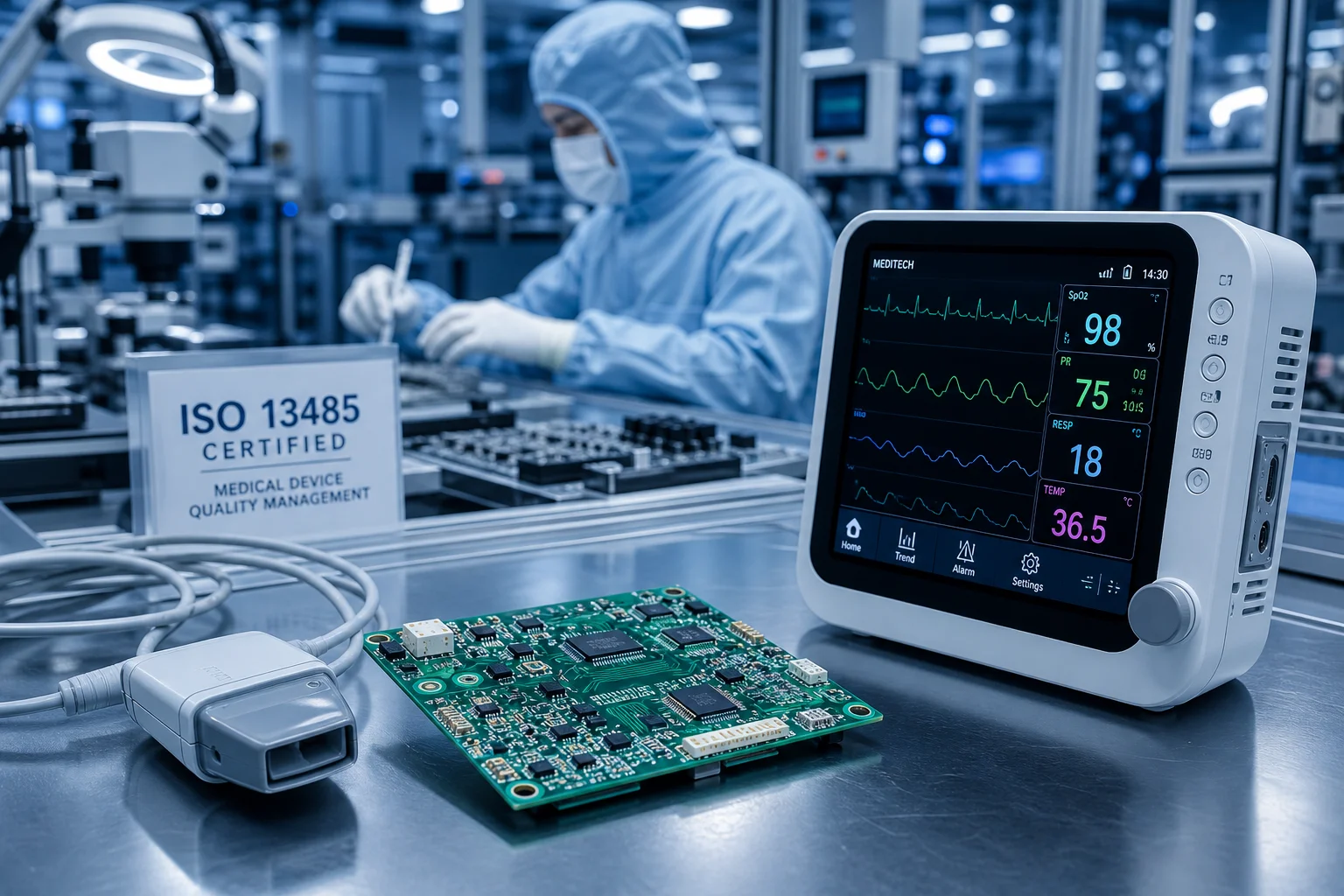
2026 Medical Device OEM/ODM Sourcing & Clinical Telemetry Guide
Medical device buyers are entering 2026 with higher expectations for traceability, clinical usability, cybersecurity, and dependable supply. This practical guide explains how to evaluate an OEM/ODM partner and turn connected vital-signs concepts into a scalable product program.
1. What to evaluate when sourcing medical devices
OEM/ODM sourcing is more than comparing a unit price. Evaluate engineering capability, quality systems, compliance readiness, and supply continuity.
- Review sensor selection, signal processing, alarm logic, battery performance, enclosure design, and usability testing.
- Request ISO 13485 scope, audit information, CAPA, complaint procedures, and change control records.
- Confirm approved alternates, safety stock, lead times, and business-continuity plans.
2. Pulse oximeter sensor boards and vital-signs platforms
Measurement quality depends on the complete signal chain: LED wavelengths, photodiodes, signal-conditioning design, optical mechanics, algorithms, motion tolerance, and calibration.
| Evaluation area | Basic offer | Production-ready partner |
|---|
| Documentation | Datasheet and sample | Requirements, verification, risk file, and change history |
| Quality control | Visual inspection | Traceable incoming, in-process, and final testing |
| Customization | Fixed board and firmware | Controlled hardware, firmware, enclosure, and packaging options |
2.1 Questions for a sensor-board supplier
- Which sensor and signal-conditioning architecture is used?
- How are motion artifact, low perfusion, skin-tone variation, and probe fit addressed?
- What test fixtures, calibration data, and production tests are available?
3. Clinical telemetry, integration, and launch readiness
Telemetry turns measurements into actionable clinical information while protecting data integrity and patient privacy.
- Capture: verify sensor quality indicators, timestamp accuracy, device association, and local buffering.
- Transmit: test Bluetooth, Wi-Fi, cellular, gateway, and offline recovery.
- Integrate: document API fields, authentication, encryption, audit logs, and interoperability.
- Define milestones and acceptance criteria.
- Validate reliability, EMC, electrical safety, biocompatibility, and cleaning as applicable.
- Plan cybersecurity response, software updates, warranty, RMA, and service levels.
Launch principle: Use representative pilot evidence to refine risk analysis, production test limits, and training before scaling.
Conclusion
Choose a partner that can support the product from concept through production and post-market service.